Wines & Châteaux
Le Terroir
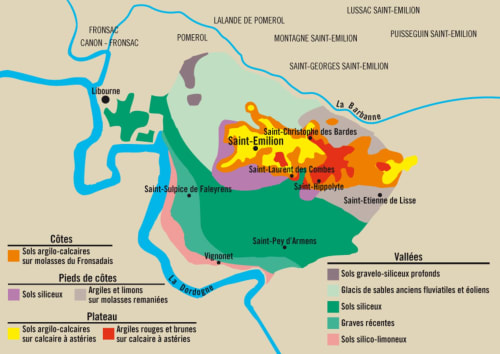
The richness of the Greater Saint-Émilion terroir stems above all from the harmonious interplay of several natural elements:
- A remarkable geological diversity, with limestone, clay-limestone, sandy and gravelly soils.
- A temperate continental microclimate.
- Gently rolling hillsides that allow the vineyards to benefit from optimal sunlight exposure.
It is this unique combination of favourable winegrowing conditions, together with the skilful blending of grape varieties predominantly Merlot, complemented by Cabernet Franc or Cabernet Sauvignon, and to a lesser extent Malbec that gives Saint-Émilion wines their remarkably nuanced range of flavours and aromas.
Source: Saint-Émilion Tourist Office

The wine
The wine syndicate established two Appellations d’Origine Contrôlée: Saint-Émilion and Saint-Émilion Grand Cru. It introduced a classification system enabling Saint-Émilion Grand Cru AOC wines to be distinguished as:
- Grand Cru Classé
- 1er Grand Cru Classé
- 1er Grand Cru Classé A.
This classification system, adopted and established by the Saint-Émilion Wine Growers’ Association (renamed the Saint-Émilion Wine Council in 2007) in 1955, is reviewed every 10 years and encourages winegrowers to strive ever closer to excellence. Its main objective is to guarantee the origin, quality and authenticity of Saint-Émilion wines.
2022 Classification: 85 estates, including 2 Premiers Grands Crus Classés A, 12 Premiers Grands Crus Classés and 71 Grands Crus Classés.
Source: Saint-Émilion Tourist Office
Classification list
Please contact us for a list of recommended places to visit.